
Skip to Content
Post-Surgical Stiffness Rehabilitation

Stiff After Surgery?
Move Better. Regain Your Function.

Evidence-informed physiotherapy for persistent stiffness after surgery, focused on restoring appropriate mobility, strength and functional movement through individualized rehabilitation.

The cause and severity of postoperative stiffness vary. Rehabilitation should be guided by the surgical procedure, healing stage, symptoms, range of motion and surgeon's precautions.
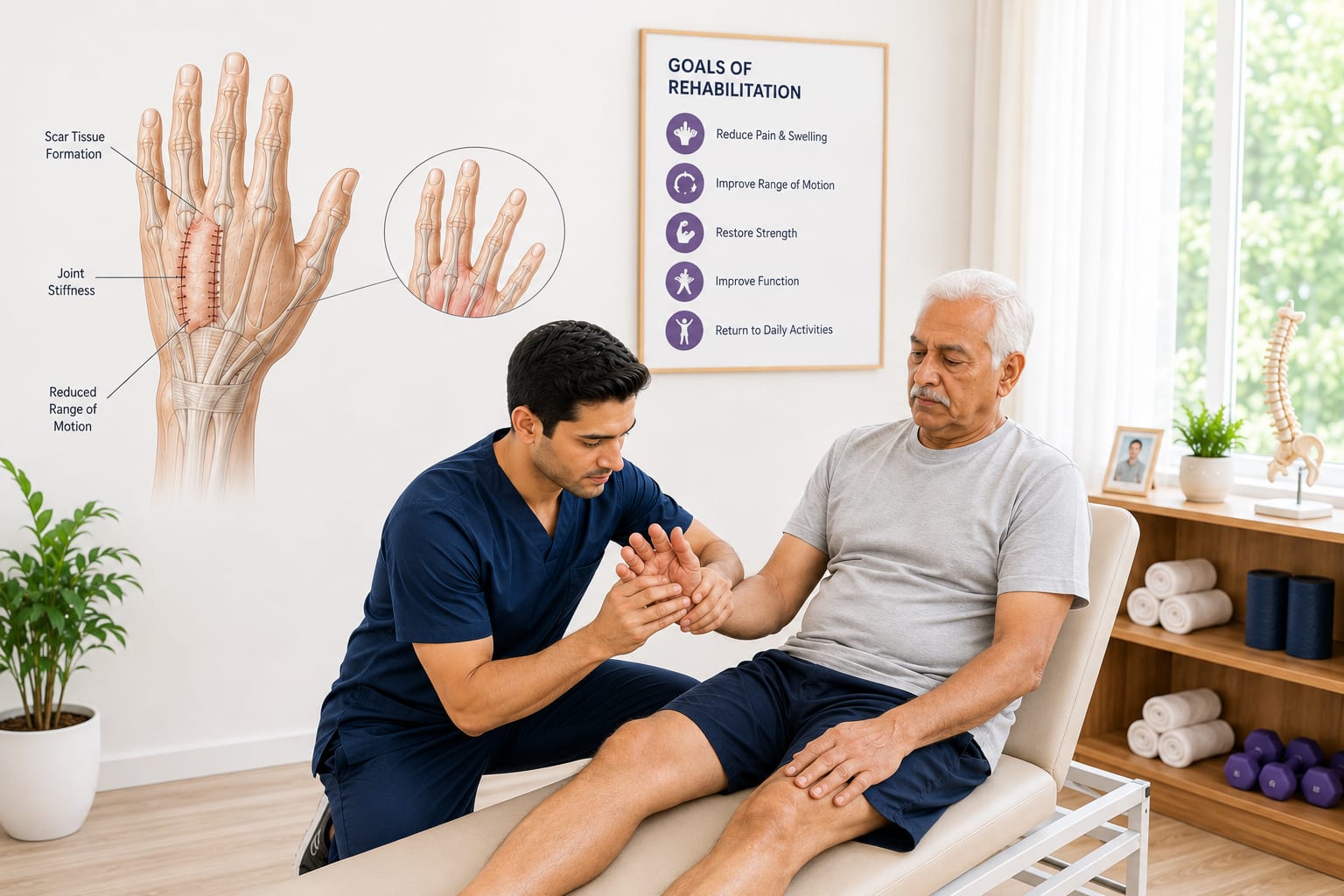
Post-surgical stiffness physiotherapy rehabilitation

Surgery may fix the problem. Movement still needs to return.

Stiffness can develop after orthopaedic surgery because of immobilization, swelling, pain, tissue healing, scar formation, muscle inhibition or other postoperative factors.

Physiotherapy can help restore appropriate range of motion, strength, movement confidence and functional ability when conservative rehabilitation is clinically appropriate.

Persistent or unexpectedly worsening stiffness may require medical reassessment to determine whether an underlying complication or mechanical restriction is contributing.

Understanding Post-Surgical Stiffness

Stiffness is not caused by one single factor. A proper assessment helps identify what may be limiting movement.

01

Prolonged Immobilization

Bracing, casting or reduced movement after surgery can contribute to loss of joint mobility and muscle capacity.

02

Pain & Swelling

Pain and postoperative swelling may limit normal movement and reduce participation in rehabilitation.

03

Scar & Tissue Restriction

Healing tissues and postoperative adhesions may contribute to restricted movement in some patients.

04

Muscle Weakness

Reduced activity after surgery can cause weakness, altered movement patterns and difficulty using the joint normally.

05

Arthrofibrosis

Excessive scar-like tissue formation inside or around a joint can cause substantial restriction and may require medical evaluation.

06

Other Postoperative Factors

Infection, complex regional pain syndrome, heterotopic ossification or mechanical factors can also contribute to postoperative stiffness and require appropriate clinical assessment.

First Understand What Is Limiting Your Movement

Treatment starts with identifying the type, severity and functional impact of the stiffness.

01

Range of Motion

Objective assessment of active and passive joint movement where clinically appropriate.

02

Pain & Swelling

Assessment of symptoms that may be restricting movement or exercise participation.

03

Muscle Strength

Identification of weakness and muscle inhibition affecting functional movement.

04

Scar & Soft Tissue

Assessment of relevant postoperative scar and soft tissue restrictions when appropriate.

05

Functional Mobility

Assessment of walking, stairs, transfers and other activities affected by stiffness.

06

Surgical Precautions

Treatment is planned around the procedure performed, healing stage and surgeon's restrictions.

Restore Movement Without Losing Sight of Healing

The goal is not simply to force more movement. Treatment is progressively adjusted according to tissue healing, symptoms, surgical precautions and functional response.

01

Mobility Exercises

Appropriate active, assisted or passive mobility work may be introduced according to the surgical procedure.

02

Progressive Stretching

Carefully selected mobility and stretching techniques can be progressed when compatible with healing.

03

Strengthening

Progressive strengthening addresses weakness and supports restoration of normal movement.

04

Functional Training

Exercises progress toward walking, stairs, transfers, daily activities and individual functional goals.

Post-Surgical Stiffness Can Affect Many Joints

Rehabilitation is adapted to the specific joint and surgery involved.

Knee Stiffness

Commonly seen after knee replacement, ligament reconstruction, fracture fixation and other knee procedures.

Shoulder Stiffness

May occur following rotator cuff repair, shoulder stabilisation, fracture surgery or other procedures.

Elbow Stiffness

Can develop after trauma, fracture fixation, immobilization or elbow surgery.

Ankle & Foot Stiffness

May follow fracture surgery, tendon repair, ligament procedures or prolonged immobilization.

Hip Stiffness

Rehabilitation may be required following hip replacement, fracture surgery or other procedures affecting hip mobility.

Wrist & Hand Stiffness

Postoperative stiffness may affect grip, dexterity, wrist movement and everyday hand function.

When Stiffness Needs More Than Routine Physiotherapy

Not every case of postoperative stiffness should simply be treated by pushing harder. Persistent or unusual symptoms may require review by the treating surgeon or another medical professional.

!

Unexpectedly Worsening Symptoms

Increasing pain, swelling or loss of function should be clinically reassessed.

!

Suspected Infection

Concerning postoperative symptoms require prompt medical evaluation rather than routine progression.

!

Severe or Persistent Restriction

Marked stiffness that does not respond as expected may require further investigation.

!

Mechanical Block

A suspected structural or mechanical limitation may need assessment by the treating surgeon.

!

Failure to Progress

If clinically appropriate rehabilitation does not produce expected progress, reassessment may be necessary.

!

Possible Arthrofibrosis

Persistent substantial restriction may require medical evaluation for arthrofibrosis or other causes.

Evidence Behind Post-Surgical Stiffness Management

Management depends heavily on the joint and surgical procedure. Current evidence supports individualized rehabilitation while recognizing that persistent stiffness may sometimes require additional medical or surgical treatment.

2026
Research

Management of Stiffness After Total Knee Arthroplasty

Recent research examining postoperative knee stiffness found that both manipulation under anesthesia and arthroscopic arthrolysis improved range of motion in selected patients, while earlier intervention was associated with greater ROM gains.

Read Research →
2026
Review

A Comprehensive Approach to Knee Arthroplasty Stiffness

Current review literature emphasizes early identification of stiffness, attention to modifiable risk factors and appropriate treatment selection when conservative rehabilitation alone is insufficient.

Read Research →
2026
Evidence Synthesis

Rehabilitation After Shoulder Stabilisation Surgery

Recent consensus recommendations identify multiple postoperative rehabilitation domains and support carefully controlled early shoulder movement within procedure-specific restrictions.

Read Research →
2026
Clinical Study

Postoperative Shoulder Stiffness After Rotator Cuff Repair

A 2026 study found that persistent stiffness at six months after rotator cuff repair was associated with poorer one-year functional outcomes, highlighting the importance of monitoring mobility during recovery.

Read Research →
What the evidence means: Post-surgical stiffness should be assessed rather than treated with a one-size-fits-all protocol. The appropriate balance between mobility, tissue protection, strengthening and further medical intervention depends on the surgery, joint, healing status and clinical findings.

Ready to Move Better After Surgery?

Get individualized physiotherapy and rehabilitation support at home across Noida, Greater Noida and Noida Extension.

Clinical Evidence & References

  1. Management of stiffness after total knee arthroplasty: influence of intervention timing and surgical technique on clinical outcomes.
    PubMed →
  2. A Comprehensive Approach to Stiffness in Total Knee Arthroplasty.
    PubMed →
  3. Critical evidence synthesis on rehabilitation following arthroscopic shoulder stabilisation surgery.
    PubMed →
  4. Prevention of postoperative shoulder stiffness after rotator cuff repair through a structured rehabilitation protocol.
    PubMed →
  5. Rehabilitation after surgical release of the stiff elbow: a literature review.
    PubMed →
Medical Disclaimer: This page provides general educational information about post-surgical stiffness rehabilitation. It does not replace assessment or advice from your surgeon, orthopaedic physician or physiotherapist. Rehabilitation should be individualized according to the surgical procedure, healing status, symptoms and clinical findings.